






























































Table of Contents
- Induction Hob vs Ceramic Hob: How They Actually Work
- Induction Hob Pan Compatibility: What Cookware You Need
- Energy Efficiency of Electric Hobs: Which Uses Less Power?
- Cooking Speed, Searing and Simmering Performance
- Safety Features: Child Locks, Pan Detection and Residual Heat
- How to Clean Induction Hob Glass and Ceramic Surfaces
- Noise, Lifespan and Repairability: The Factors Most Guides Skip
- Conclusion
- Frequently Asked Questions
Last Updated: September 12, 2026
Induction Hob vs Ceramic Hob: How They Actually Work
Choosing between an induction hob vs ceramic hob comes down to one question: do you want speed and precision, or simple familiarity? Both sit under smooth black glass, but they heat food in completely different ways. This guide from iHome Direct covers how each works, what pans you need, running costs, safety, cleaning, and the details most buying guides leave out.
Here is the short answer. An induction hob is a glass-topped electric hob that heats the pan itself using a magnetic field, while a ceramic hob is a glass-topped electric hob that heats the surface first and passes that heat to the pan. That single difference explains almost everything else: speed, running cost, pan rules, and how hot the surface stays afterwards.
The Magnetic Field Behind Induction Cooking
Induction cooking works by generating a magnetic field beneath the glass. A copper coil sits under each zone, and when you switch the hob on, alternating current creates a rapidly changing electromagnetic field. When a pan with a ferrous metal base sits on the zone, the field induces circulating currents inside the base, and the pan becomes its own heating element.
Two consequences follow. First, the glass barely warms, so pan detection can sense whether a suitable pan is present and auto-shutoff can cut the zone when you lift it away. Second, heat appears and stops almost instantly, which is why induction offers precise temperature control and rapid heating.
Radiant Heat and the Ceramic Hob Element
A ceramic hob hides a resistive heating element under a glass-ceramic surface. Switch it on and the element glows, transferring energy as radiant heat through the glass to whatever sits on top. The surface itself reaches cooking temperature, and heat spreads across the zone rather than staying inside the pan.
That design brings residual heat: after you switch a ceramic zone off, the surface stays hot for several minutes, so a residual heat indicator matters. Heat distribution also depends on how flat your pan base is, because a warped base leaves gaps where radiant transfer is weaker.
Induction Hob Pan Compatibility: What Cookware You Need
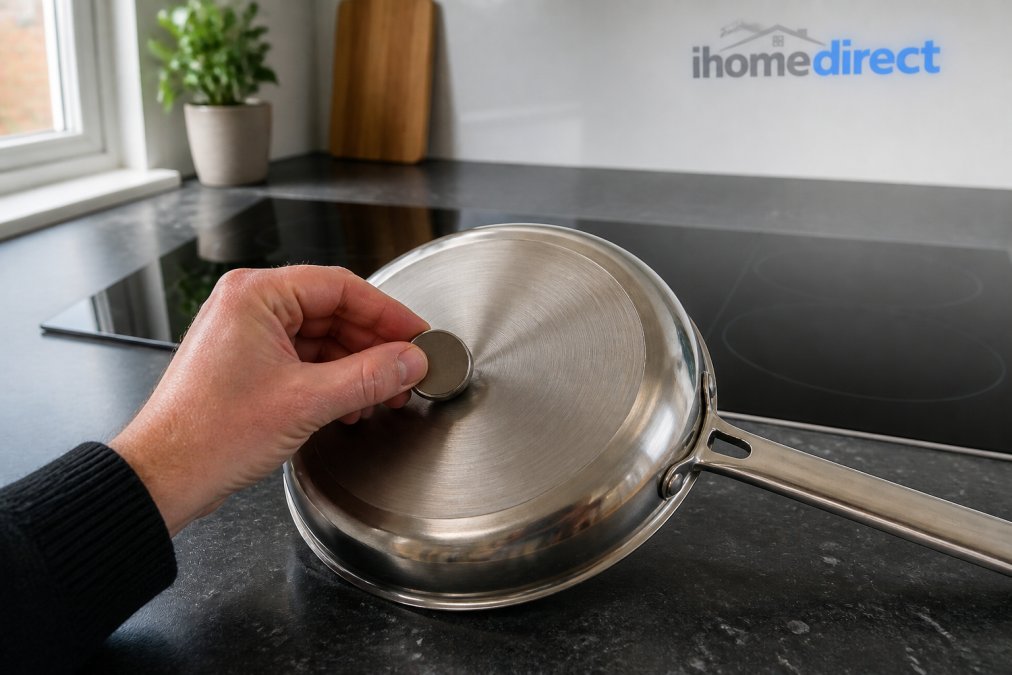
Induction hobs only work with cookware that a magnet will stick to. If a magnet clings firmly to the base of a pan, that pan will work on an induction zone. If it does not, the zone will not heat it properly, and pan detection may refuse to start.
The Magnet Test: A Two-Minute Routine Before You Buy
Most guides tell you to use a magnet. Few tell you how. Here is a two-minute routine that saves you from a hob that refuses to heat half your cupboard.
- Take a fridge magnet, the stronger the better. A weak promotional magnet can give a false negative on thinner steel pans.
- Turn each pan upside down and press the magnet against the centre of the base, not the rim, which is often a different material.
- Test the outer edge too. Some pans have a ferrous disc bonded into the middle only, so the outer ring will not heat evenly.
- If the magnet clings firmly and is hard to slide off, the pan is suitable. If it slides off easily or falls away, it is not.
- If the magnet sticks only weakly, the pan will heat slowly and unevenly. Treat it as a backup rather than a daily pan.
Which Materials Work and Which Do Not
Cast iron, most stainless steel, and enamelled steel pans are usually fine. Pure aluminium, copper, and many glass or ceramic dishes are not, unless the manufacturer has added a ferrous metal plate to the base. A common mistake is assuming a heavy, expensive pan must be induction-ready. Weight tells you nothing; the base material does.
Some pans sold as 'induction compatible' have only a thin ferrous layer. These heat, but the layer can warp over time and the pan may hum or lose contact with the zone. A thicker sandwich or encapsulated base holds its shape better and heats more evenly.
Base Flatness Matters More Than You Think
A flat base is essential on induction. The magnetic field couples best when the pan sits flush against the glass. A concave or convex base leaves an air gap, and the hob may refuse to detect the pan or cycle on and off as it struggles to read the load.
Test flatness by placing a steel ruler across the base of an upside-down pan. If you can see daylight under the middle, the base is bowed. Small bows are usually tolerable; large ones are not. On a ceramic hob, a warped base matters less because radiant heat spreads across the zone, but it still wastes energy and cooks unevenly.
Pan Size and Zone Size
Induction zones are less forgiving about pan size than ceramic ones. A pan much smaller than the marked zone may not be detected at all, because the hob cannot sense enough metal over the coil. A pan that overhangs badly will heat at the centre and stay cool at the edges. Match the pan base to the zone marking, and avoid a pan more than about a third smaller than the zone.
What to Do With Pans That Fail the Test
If you already own pans you love, buy a small magnet before you buy the hob and test every pan you use regularly. The ones that fail can still be used with a thin induction interface disc, though that adds a layer between pan and glass and slows response, reducing the precision that makes induction appealing. It is a compromise rather than a solution.
If most of your cookware fails the test, a ceramic hob is the simpler choice. It works with any flat-bottomed pan, so nothing in your cupboard becomes redundant overnight.
Energy Efficiency of Electric Hobs: Which Uses Less Power?
Induction is the more energy-efficient of the two because it heats the pan rather than the air and glass around it. A ceramic element must first heat itself and the glass-ceramic surface before any energy reaches the food, and some of that warmth escapes into the room.
The energy efficiency of electric hobs is judged by how much of the power drawn actually ends up in the pan. Induction keeps a higher share there, because less heat is wasted on the hob surface and surrounding air. The gap is widest on short tasks: boiling water, reheating a portion, or simmering for ten minutes.
Wattage matters too. A typical induction zone draws power in short, intense bursts, while a ceramic zone runs longer at a steadier draw to hold the same temperature. Over a year of daily cooking, the difference shows up on the bill, though how much depends on how often and what you cook.
Cooking Speed, Searing and Simmering Performance
Induction wins on speed and control; ceramic wins on gentle, even warmth. An induction zone reaches searing temperature in a fraction of the time a ceramic zone needs, and responds almost at once when you turn the control down. That responsiveness suits searing, reducing sauces, and anything where timing matters.
Ceramic is slower to heat and cool, which some cooks prefer for simmering and slow reductions. The residual heat in the glass keeps working after you turn the dial down, so you can finish a dish on stored warmth. The trade-off is that you cannot drop the temperature quickly, making delicate sauces harder to control.
For everyday family cooking, both do the job. For anyone who cooks with high heat and wants tight control, induction is the more capable choice.
Safety Features: Child Locks, Pan Detection and Residual Heat
Induction is the safer surface in a busy kitchen, mainly because the glass stays comparatively cool. The heat lives in the pan, so a child safety lock, pan detection, and auto-shutoff work together to reduce risk. Lift the pan and the zone stops; leave a zone on with nothing on it and the hob shuts it down.
Ceramic hobs rely on residual heat warnings and boil-over protection rather than pan detection. The surface gets hot enough to burn and stays that way after cooking ends, so a residual heat indicator is the main safety feature, not a nicety.
Neither type removes the need for care. Hot pans, splashes, and wandering hands are the real risks on any hob.
How to Clean Induction Hob Glass and Ceramic Surfaces
Both hobs clean more easily than gas, and the routine is much the same: let the surface cool, wipe with a soft cloth and warm soapy water, then use a dedicated glass-ceramic cleaner for stubborn marks.
Learning how to clean induction hob glass well comes down to timing. Wipe spills while soft rather than baked on, and avoid abrasive pads or scourers, which dull the finish. Sugar and starchy spills are the exception: lift them while the surface is still warm, using a glass-ceramic scraper, because they can pit the glass if left to cool and harden.
Ceramic surfaces need the same care, with one addition: because the glass itself gets hot, burnt-on residue is more common, so patience with a scraper and cleaner pays off. Never use a steam cleaner or harsh chemicals on either surface, and never pour cold water onto a hot hob, which can cause thermal shock and crack the glass.
Noise, Lifespan and Repairability: The Factors Most Guides Skip
The detail nobody mentions is the noise. Induction hobs are not silent: the electronics and cooling fans produce a low hum, and some pans buzz faintly when the magnetic field interacts with their base. Thin, cheap pans are the worst offenders; a well-made pan with a solid base is quieter. Ceramic hobs are effectively silent apart from the click of the controls.
What Actually Causes the Noise
Induction noise comes from three places, and knowing which is which tells you whether it is a fault or normal operation.
- The cooling fan. The power electronics under the glass generate heat and need moving air. A low, steady hum that starts when you switch on and stops a minute or two after you switch off is the fan doing its job.
- Pan buzz. A faint buzz or whistle that changes with the power setting comes from the pan base vibrating as the magnetic field switches rapidly. Pans with a thin or loosely bonded base are the worst offenders; a heavy, well-made pan buzzes far less or not at all.
- Control clicks. A soft click when a zone cycles on or off is the relay or power modulation at work, not a fault.
If the noise is annoying in an open-plan kitchen, try a different pan first. If it persists with a known-good pan, the hob may need attention. Ceramic hobs avoid all of this because there is no magnetic field and, in most models, no fan, though some have one for the controls.
Lifespan: What Tends to Fail and When
Both types are built around a glass-ceramic surface and electronic controls, and both can be repaired rather than replaced if a single zone or the control board fails, provided parts are available. The difference is what tends to go wrong.
On a ceramic hob, the heating element is a simple, robust resistive coil under the glass; the most common failures are a cracked surface or a burnt-out element after many years. On an induction hob, the electronics are more complex: power boards, cooling fans, and sensors sit under the glass, and these are the parts most likely to fail first and most sensitive to heat, moisture and poor ventilation.
A practical point most guides miss: installation affects lifespan. An induction hob needs clearance beneath it for airflow, as set out in the maker's instructions. Fitting one into a tight cabinet with no ventilation shortens the life of the electronics. Ceramic hobs are less fussy about airflow because they generate less heat under the glass, though they still need the specified clearances.
Repairability: What You Can and Cannot Fix
A cracked glass-ceramic surface cannot be repaired at home, and a replacement top often costs a large share of a new hob. That is true of both types. Beyond the glass, the picture differs.
- Ceramic hobs are often repairable by replacing a single element or the control switch. Parts are simple and often still available years after purchase.
- Induction hobs are repairable too, but the parts are more specialised. A failed power board or fan can usually be replaced, but the part plus labour can approach the price of a new hob, especially on budget models.
Before buying either type, check that the maker offers spare parts and that the model has a reasonable warranty. A longer warranty signals that the maker expects the electronics to last. Keep the receipt and installation paperwork in case you need to make a claim.
Environmental Impact Beyond Energy
On environmental impact beyond energy, induction's advantage is efficiency rather than materials. Less wasted heat means less power drawn for the same cooking, and a hob that lasts longer avoids the waste of manufacturing a new one. Buying pans that suit your chosen hob, rather than replacing them later, matters just as much. Repairing rather than replacing also keeps glass, metal and electronics out of the waste stream for longer, which is worth weighing against induction's higher upfront cost.
| Feature | Induction Hob | Ceramic Hob |
|---|---|---|
| How it heats | Magnetic field heats the pan | Radiant heat through the glass |
| Cookware | Ferrous metal base only | Any flat-bottomed pan |
| Speed and control | Very fast, precise | Slower, residual heat |
| Surface heat | Stays comparatively cool | Gets hot, stays hot |
| Noise | Fan hum, occasional pan buzz | Effectively silent |
| Cleaning | Easy, cool surface | Easy, but hot residue |
| Best for | Speed, safety, control | Simplicity, existing pans |
Conclusion
The choice between an induction hob vs ceramic hob for modern kitchens is really a choice about how you cook. Induction suits anyone who wants speed, tight control, and a cooler, safer surface, and who is happy to check their pans with a magnet first. Ceramic suits anyone who wants a straightforward hob that works with the pans they already own and cooks gently and quietly.
Whichever way you lean, iHome Direct stocks affordable kitchen essentials and household appliances designed for modern homes, backed by fast delivery and secure checkout. Browse our kitchen range to compare hobs and cookware side by side. Get started with iHome Direct and bring lasting comfort and effortless style to your kitchen.
Frequently Asked Questions
Are induction hobs better than ceramic hobs?
It depends on your priorities. Induction hobs heat faster, respond to temperature changes almost instantly and use less energy because the magnetic field heats the pan directly rather than the surface. Ceramic hobs cost less to buy, work with any flat-bottomed pan and suit cooks who prefer visual heat cues. For most modern kitchens where speed and running costs matter, induction tends to win, but ceramic remains a solid choice on a tighter budget.
Do I need special pans for an induction hob?
Yes. Induction cooking relies on a magnetic field, so your cookware must have a ferrous metal base. Test any pan by holding a magnet against its underside: if it sticks firmly, the pan will work. Cast iron, most stainless steel and enamelled steel pans are fine. Aluminium, copper and glass cookware will not heat unless they carry an induction-ready base plate.
Is it difficult to clean an induction hob compared to a ceramic one?
Induction hobs are generally easier to clean. Because the surface stays cooler, spills are less likely to bake on, so a quick wipe with a soft cloth and ceramic hob cleaner usually does the job. Ceramic hobs get hotter and food can burn onto the glass-ceramic surface, which may need a scraper. For both types, avoid abrasive pads to protect the scratch resistance of the glass.
Do induction hobs require a specific electrical installation?
Most induction hobs draw more power than ceramic models and often need a dedicated circuit rated for higher wattage, typically installed by a qualified electrician. Some plug-in models exist but tend to be less powerful. If you are replacing a ceramic hob during a kitchen renovation, check the existing wiring first, as an upgrade to the consumer unit may be needed before installation.