

























































Table of Contents
- Why Quiet Blenders Matter in UK Homes
- How We Test Quiet Blenders for Home Use
- Key Features to Look for in a Quiet Blender
- Quiet Mark Certified Kitchen Appliances: What You Need to Know
- How to Reduce Blender Noise: Practical Tips
- Compact vs Full-Size Quiet Blenders for Small Kitchens
- Ease of Cleaning and Long-Term Durability
- Frequently Asked Questions
Last Updated: September 16, 2026
Why Quiet Blenders Matter in UK Homes
A noisy blender is one of the most common complaints in shared households, and it is easy to see why. Many kitchens sit directly beside a living room or bedroom wall, so a loud motor travels further than most people expect. Quiet blenders for home use UK reviews often focus on blending power alone, but sound is the feature buyers notice every single day.
How We Test Quiet Blenders for Home Use
Testing a blender for noise is straightforward once you remove the guesswork. We run each model through the same tasks at the same distance, so results are comparable rather than based on a quick first impression.
Key Features to Look for in a Quiet Blender
The features that reduce noise are fairly consistent across good models, but it helps to understand why each one works. Two blenders with the same wattage can differ by 10-15 dB in practice, which is roughly the difference between a normal conversation and a vacuum cleaner. Look for a sturdy base, a well-fitted lid, and a motor that holds a steady speed rather than surging.
Motor Power vs Noise Levels
More power does not automatically mean more noise. A well-engineered motor can run smoothly at a lower pitch, while a cheap high-wattage motor often whines. Peak power matters for crushing ice, but a motor with good thermal protection and steady variable speed control usually sounds calmer. In practice, a mid-range motor with solid insulation beats a budget powerhouse every time.
Noise Reduction Technology
Noise reduction technology covers a few different approaches, and they do not all work the same way. Some blenders use an acoustic shield or a sound-dampening base; others rely on vibration dampening and suction feet that keep the machine still. Vacuum blending, where air is removed from the jug, also cuts noise because there is less resistance inside. None of these are magic, but together they make a real difference.
It is worth understanding the two main mechanisms:
- Acoustic enclosures work by trapping airborne noise inside a physical barrier. A well-sealed shield can cut perceived noise by around 10-15 dB, but only if the seal is tight. A loose or poorly fitted shield lets noise escape and can even amplify certain frequencies.
- Motor insulation and mounting work differently. Here, the goal is to stop vibration from reaching the base and the countertop. Rubber grommets, a floating motor mount, and a heavy base plate absorb vibration before it becomes sound. This approach tends to reduce low-frequency rumble rather than high-pitched whine.
| Feature | What It Does | Why It Helps | Typical Noise Benefit |
|---|---|---|---|
| Acoustic shield | Encloses the jug | Blocks airborne motor and blade noise | 10-15 dB reduction if well sealed |
| Suction feet | Grip the counter | Cuts vibration rattle | 2-5 dB reduction |
| Variable speed control | Slows the start | Avoids sudden noise spikes | Prevents 5-8 dB peaks at startup |
| Thermal protection | Guards the motor | Prevents strained, louder running | Maintains steady noise over time |
| Brushless motor | Fewer contact points | Reduces high-frequency whine | 5-10 dB quieter under load |
UK Electrical and Safety Considerations
High-wattage kitchen appliances in the UK run on a 230 V supply, and most kitchens have ring circuits protected by a 13 A fuse. A blender drawing 1000-1500 W is well within that limit, but it is worth checking the plug and cable rating before buying a high-power model. Look for a moulded plug with a BS 1363 approval mark and a cable that is at least 0.75 mm².
Quiet Mark Certified Kitchen Appliances: What You Need to Know
Quiet Mark certified kitchen appliances carry a label awarded by the UK Noise Abatement Society. The scheme tests products for noise and recognises those that are quieter than typical models in their category. It is a useful shortcut, but it is not the only measure of quality.
How to Reduce Blender Noise: Practical Tips
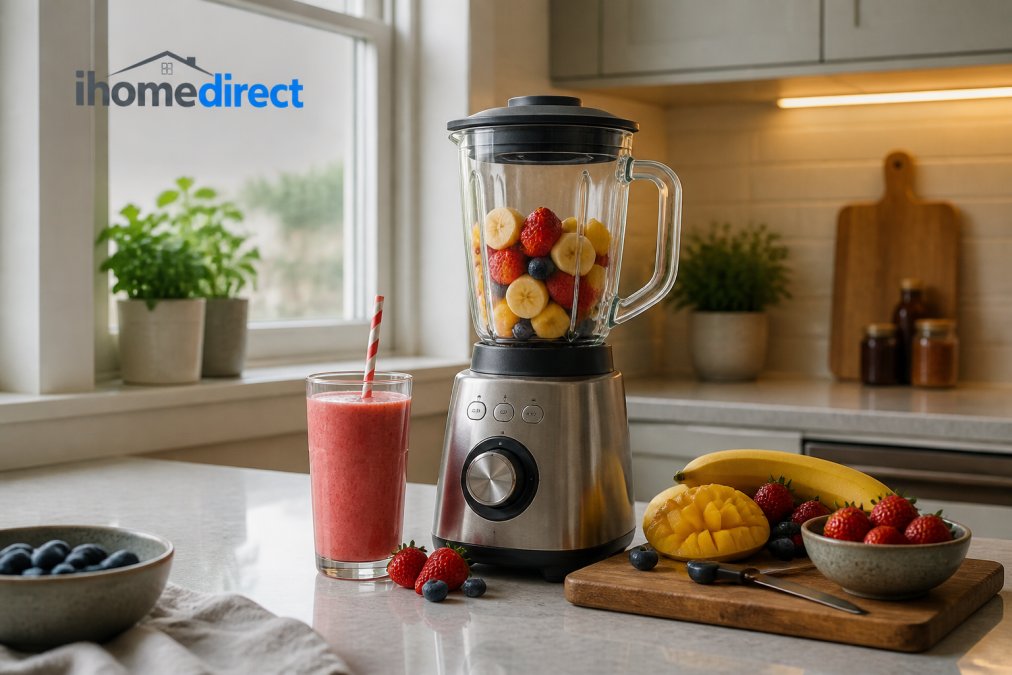
You can cut blender noise without buying anything new. The simplest fix is to place the machine on a folded towel or a rubber mat, which absorbs vibration before it reaches the counter. Filling the jug in the right order helps too: liquid first, then soft items, then ice on top, so the blades are not fighting a solid block.
Compact vs Full-Size Quiet Blenders for Small Kitchens
Small kitchens need a blender that earns its countertop footprint. A compact model with a smaller jug capacity suits one or two people and tucks away easily, while a full-size blender handles larger batches but takes up more room. The difference in noise between the two categories is often smaller than buyers expect, a well-designed compact can be quieter than a poorly insulated full-size model.
Space and Capacity in Practice
Most compact blenders stand around 30-35 cm tall with a 600-800 ml jug, which fits under a standard 45 cm wall cupboard. Full-size models are typically 40-48 cm tall with a 1.5-2 litre jug, so they need open counter space or a tall cupboard. If you are renting a flat with limited space, measure your counter and cupboard height before buying.
Long-Term Noise Degradation
One thing most reviews miss is how noise changes over time. A blender that starts quiet can become noticeably louder after 12-24 months of regular use. The two main causes are motor wear and blade dullness.
- Motor wear: Brushed motors lose efficiency as the brushes wear down, which makes the motor work harder and run louder. Brushless motors degrade more slowly, which is one reason they are worth the extra cost if you blend daily.
- Blade dullness: Dull blades do not cut as cleanly, so the motor has to spin faster or longer to achieve the same result. That extra effort shows up as increased noise. Replacing the blade assembly every 12-18 months, or when you notice a change in blending time, can keep noise levels closer to the original.
- Seal and bearing wear: Worn jug seals and motor bearings allow more vibration, which translates into more sound. A simple check is to run the blender empty for a few seconds every few months and listen for new rattles or squeaks.
Matching the Blender to Your Kitchen
Neither compact nor full-size is better in every case; the right choice depends on how much you blend and how much space you have. As a rough guide:
- One or two people, limited counter space: a compact 600-800 ml model with a brushless motor and suction feet.
- Family of three or more, blends daily: a full-size 1.5-2 litre model with an acoustic shield and variable speed control.
- Renting or moving often: a compact model with fewer parts and a simple design is easier to pack and less likely to be damaged in transit.
Ease of Cleaning and Long-Term Durability
Cleaning and durability decide whether a blender lasts years or months. Jugs that are dishwasher safe save the most time, and stainless steel blades resist dulling better than coated ones. A base with good material durability and a sealed motor housing is less likely to fail.
Frequently Asked Questions
What is the quietest blender available in the UK?
The quietest blenders typically feature acoustic enclosures or sound-dampening technology, with decibel ratings often between 70 and 85 dB. Models with Quiet Mark certification are independently verified for low noise. For home use, look for blenders with suction feet and vibration dampening to further reduce noise. Always check the decibel rating before buying, as quieter models usually cost more but are worth it for open-plan living.
Are Quiet Mark certified blenders actually quieter?
Yes, Quiet Mark certification means the appliance has been tested against rigorous acoustic standards and meets specific noise reduction criteria. Certified blenders typically operate at lower decibel levels than non-certified models. However, actual noise can vary depending on ingredients and speed settings. Certification is a reliable indicator, but it's still worth reading user reviews for real-world noise experiences.
How do I choose a blender that won't wake the household?
Look for blenders with decibel ratings below 85 dB, acoustic shields, and rubberised bases. Consider a model with variable speed control so you can start slow and avoid sudden noise spikes. Compact blenders with smaller motors may be quieter but less powerful. Also, place the blender on a stable surface and use a silicone mat to reduce vibration. Reading reviews from other UK buyers can help you gauge real noise levels.
Is it worth paying more for a noise-reduction blender?
If you live in a flat or have an open-plan kitchen, paying more for a noise-reduction blender can be worthwhile. Quieter models often have better build quality, longer warranties, and features like thermal protection and dishwasher-safe parts. They also reduce noise pollution, making them more pleasant to use daily. However, if noise isn't a major concern, a standard blender may suffice. Balance your budget with how often you'll use it.
Choosing a quiet blender comes down to matching motor design, jug size and your kitchen layout, rather than chasing the biggest wattage. At iHome Direct, we stock affordable kitchen essentials and household appliances chosen for modern homes, with fast delivery and secure checkout to make setting up your space simple. Browse our range of compact and full-size blenders, and find a model that brings lasting comfort to your kitchen without the noise.